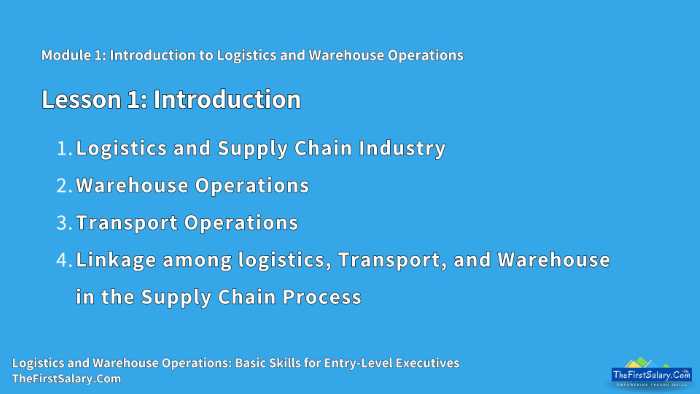
Module 1: Introduction to Logistics and Warehouse Operations
Lesson 1: Introduction
Logistics, warehouse operations, and transport are key components in moving goods from production to the customer. This lesson introduces the basics of logistics, how warehouses operate, and the role of transportation in the supply chain. By the end of the lesson, learners will understand how these areas are interconnected and their importance in delivering products efficiently.
Key Concepts:
- Logistics and Supply Chain Industry
- Warehouse Operations
- Transport Operations
- The Link Between Logistics, Transport, and Warehousing
1. Logistics and Supply Chain Industry
Logistics is the process of managing how resources are acquired, stored, and transported to their final destination. The supply chain includes all the steps involved in delivering a product, from manufacturing to the end consumer. Logistics is the backbone of the supply chain, ensuring that goods are moved smoothly.
Key functions in logistics include:
» Procurement: Sourcing materials needed for production.
» Inventory Management: Keeping track of stock and its availability.
» Transportation: The movement of goods from one location to another.
» Information Systems: Technology used to track and manage the supply chain processes.
Example: A company manufactures mobile phones. The logistics team ensures that all parts are sourced, stored, and delivered to the assembly plant on time. After the phones are assembled, logistics ensures that the final products are delivered to retail outlets and online customers.
2. Warehouse Operations
A warehouse is a space where goods are stored before being distributed. The efficiency of warehouse operations is crucial in the logistics industry. Warehouses help businesses maintain inventory, fulfill customer orders, and manage returns. Good warehouse management includes proper organization of goods, maintaining safety standards, and using technology to track stock.
Key warehouse operations include:
» Receiving: Accepting goods into the warehouse.
» Storing: Organizing items so they can be easily located.
» Picking: Selecting the right products to fulfill an order.
» Packing: Preparing items for shipment.
» Shipping: Sending the goods to their destination.
Example: An e-commerce company receives thousands of items daily. Efficient warehouse operations ensure that items are sorted, stored, and shipped out to customers within 24 hours, reducing delivery times and improving customer satisfaction.
3. Transport Operations
Transport operations refer to the movement of goods from one place to another, often between suppliers, manufacturers, and customers. Effective transportation ensures that goods are delivered on time and in good condition. Different modes of transportation include trucks, ships, planes, and trains.
Key factors in transportation include:
» Timeliness: Ensuring goods arrive on schedule.
» Cost-effectiveness: Choosing the most economical transportation methods.
» Safety: Ensuring products are protected during transit.
Example: A food company ships frozen goods across the country. To keep products fresh, they use refrigerated trucks, ensuring that goods reach stores on time and in perfect condition.
4. Linkage Among Logistics, Transport, and Warehouse in the Supply Chain Process
The relationship between logistics, transport, and warehouse operations is essential for a smooth supply chain. Each plays a crucial role in ensuring that products reach their final destination efficiently. Warehouses store the products, logistics plans the transportation routes, and transport operations ensure that products are moved from one point to another.
The steps are interconnected:
» Goods are stored in a warehouse.
» Logistics plans how these goods will be transported.
» Transport ensures the goods are moved to the next stage or the customer.
Example: A clothing retailer stores its products in a warehouse. The logistics team plans the delivery routes, ensuring that the right stores receive the correct items on time. Transport operations carry out the delivery, ensuring the goods arrive safely.
» Practical Application
1. Understand the key elements of logistics, including procurement, inventory management, and transportation.
2. Observe how warehouses manage inventory and improve efficiency using technology.
3. Study how transportation links the entire supply chain, ensuring goods move from one point to another.
To apply these concepts: Review a real warehouse operation, visit a warehouse (or observe one in an online video) to see how products are stored, picked, and shipped. Analyze transport routes; Map out how a local company transports goods from their warehouse to their customers.
» Tasks
Assign roles for a simulated company, including logistics planner, warehouse manager, and transport coordinator. Create a plan for moving goods from a warehouse to a store. Discuss challenges that might arise.
» Example
In a retail business, logistics teams must ensure that products reach stores in time for seasonal sales. If transportation is delayed, the warehouse might run out of stock, causing delays and lost sales. Logistics planners use transportation management systems to track deliveries, ensuring that products are shipped efficiently.
Questions:
1. Why is it important for logistics, transport, and warehouse operations to work together?
Answer: To ensure that products are delivered on time and efficiently, minimizing delays and maximizing customer satisfaction.
2. What role does the warehouse play in the logistics process?
Answer: The warehouse stores goods before they are transported to their final destination, playing a key role in inventory management.
» Common Mistakes
• Poor Communication between Teams: Failure to coordinate between warehouse, logistics, and transport teams can lead to delays.
• Overstocking or Understocking: Not managing inventory properly can lead to wastage or lack of stock for orders.
• Inefficient Transport Routes: Choosing costly or slow routes can increase delivery times.
» Summary
In this lesson, we learned about the logistics and supply chain industry, warehouse operations, and transportation’s role in the supply chain. These functions work together to ensure that goods are delivered efficiently. Understanding how these areas link can help improve business operations and customer satisfaction.
» Takeaways:
• Logistics is essential for moving goods efficiently.
• Warehouses store and organize products.
• Transportation links the supply chain from warehouse to customer.
» FAQs
1. What is logistics?
Logistics is the process of managing how products are stored and moved through the supply chain.
2. Why are warehouses important?
Warehouses help businesses store goods, organize inventory, and fulfill customer orders.
3. What modes of transportation are used in logistics?
Common modes include trucks, ships, trains, and airplanes.
4. How do logistics, warehouse, and transportation work together?
They coordinate to move products from the manufacturer to the customer efficiently.
5. What happens if there is a delay in transportation?
Delays in transportation can cause stock shortages, affecting customer orders.