Module 1: Office Politics and Personal Growth
Lesson 3: How to Communicate Well at Work
Effective communication is essential for success in any workplace. Knowing how to speak clearly, listen actively, and adjust your communication style can help you build stronger relationships with colleagues and superiors. By the end of this lesson, you will understand the importance of communication and how it can help you navigate office politics effectively.
Key Concepts
• Speaking and Listening Skills
• Body Language in Communication
• Adjusting Your Communication for Different People
1. Speaking and Listening Skills
Lets understand the Communication Elements and Communication Cycle.
» Elements
It has four major elements including Speaker, Message, Listener and Feedback.
• Speaker: Initiates the conversation. Uses verbal and non-verbal cues to convey a message. Key elements are;
– Clarity of message.
– Tone of voice.
– Body language (gestures, facial expressions).
• Message: The information being conveyed. Can be verbal (spoken or written) or non-verbal (body language, facial expressions). Key elements are;
– Content (what is being said).
– Context (the situation in which the message is delivered).
• Listener: Receives the message. Engages in active listening (paying attention, providing feedback). Key Elements are;
– Understanding the message.
– Interpreting non-verbal cues.
• Feedback: The listener’s response to the speaker. Can be verbal (asking questions, summarizing) or non-verbal (nodding, facial expressions). Key elements are;
– Confirms understanding.
– Provides additional insights or clarifications.
• Adjustment: Both speaker and listener may adjust their communication based on feedback. This can involve changing tone, clarifying points, or modifying body language. Key elements are;
– Flexibility in communication style.
– Willingness to adapt based on interactions.
» Communication Cycle
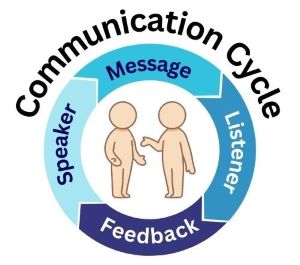
• The cycle begins with the Speaker who conveys a Message using both verbal and non-verbal cues.
• The Listener receives and interprets this message.
• The Listener provides Feedback to the Speaker, which may lead to adjustments in the ongoing communication.
• This process is continuous, promoting effective interaction and understanding between both parties.
» Speaking Skills
To communicate well at work, the way you express yourself matters. Speaking clearly and confidently can help you get your point across and ensure that others understand your message.
• Be Clear and Direct: Use simple language to explain your ideas.
• Be Confident: Speak in a firm and steady voice to show confidence.
• Stay on Topic: Focus on the main point to avoid confusion.
» Listening Skills
Good communication isn’t just about speaking; listening actively is equally important. This helps you understand others’ viewpoints, avoid misunderstandings, and respond effectively.
• Active Listening: Show that you are paying attention by nodding, asking questions, and making eye contact.
• Avoid Interruptions: Let the other person finish speaking before you respond.
• Summarize What You Hear: Repeat or summarize what the other person said to confirm you understand.
Example: In a meeting, if a colleague shares an idea, actively listen by nodding and asking relevant questions. After they finish, summarize their points by saying, “So, you’re suggesting that we try a new strategy for our marketing efforts, correct?”
2. Body Language in Communication
Non-verbal communication, like body language, plays a huge role in how your message is received. Positive body language can enhance your communication, while negative body language can send the wrong signals.
» Maintain Eye Contact
It shows that you are confident and attentive.
» Open Posture
Keep your arms relaxed at your sides to appear approachable.
» Nodding
It encourages the speaker and shows you are engaged in the conversation.
» Facial Expressions
Use expressions that match your words to avoid confusion.
Example: If you’re explaining a new idea, standing tall with open posture and maintaining eye contact will make you appear confident and credible.
3. Adjusting Your Communication for Different People
Not everyone communicates in the same way, so it’s important to adjust your communication style depending on who you’re speaking with. Whether you are talking to a manager, colleague, or client, tailoring your approach can make your message more effective.
» Formal vs. Informal Communication
Speak more formally with superiors or clients and more casually with close colleagues.
» Adjust Tone and Language
Use professional language for formal settings, but simplify your words when explaining things to someone less familiar with the topic.
» Understand Cultural Differences
Different cultures have unique communication styles. Be aware of these differences and adjust your communication as needed.
Example: When talking to your boss, you may use formal language like “I propose we explore this idea further.” However, when speaking to a peer, you could say, “What do you think about trying this out?”
» Practical Application:
To apply these communication strategies in a real work environment:
• Practice Active Listening: In your next meeting, focus on listening without interrupting and summarizing others’ ideas before sharing your opinion.
• Use Positive Body Language: Next time you give a presentation or share an idea, ensure your posture, facial expressions, and eye contact support your message.
• Adjust Your Communication Style: The next time you communicate with someone in a different role (such as a manager vs. a co-worker), consciously adjust your tone and formality to match the situation.
» Practical Task:
You are presenting a new project idea in a team meeting. Practice active listening by encouraging feedback from your team members, using positive body language while they speak. Then, adjust your response to fit the formal nature of the meeting.
» Example:
You are discussing a deadline with your manager. You actively listen to their expectations and say, “I understand the deadline is tight, but I will prioritize the tasks and keep you updated on my progress.” This shows clear communication, confidence, and adjustment in tone.
Questions and Answers:
1. Why is active listening important in the workplace?
Answer: It helps ensure you understand the message, reduces misunderstandings, and shows respect to the speaker.
2. How can body language affect communication at work?
Answer: Positive body language can enhance your message and show confidence, while negative body language can send mixed signals.
» Common Mistakes
• Interrupting Others: Cutting someone off mid-sentence can lead to misunderstandings and frustration.
• Ignoring Non-verbal Cues: Not paying attention to body language can result in miscommunication.
• Being Too Formal or Too Casual: Using inappropriate language or tone for the situation can create barriers in communication.
» Summary
Effective communication at work involves speaking clearly, listening actively, and adjusting your style based on the person you are interacting with. These skills can help you build better relationships and succeed in your workplace.
» Takeaways:
• Speak clearly and confidently.
• Listen actively and without interrupting.
• Use positive body language to reinforce your message.
• Adjust communication style for different people and situations.
» FAQs:
1. Why is active listening important?
Active listening helps you understand others better and avoids misunderstandings.
2. How can body language improve communication?
Positive body language like eye contact and open posture shows confidence and attentiveness.
3. When should you adjust your communication style?
You should adjust your style based on the formality of the situation and the person you’re speaking to.
4. What is one key aspect of speaking confidently at work?
Maintaining a steady and firm tone of voice helps convey confidence.
5. How can I improve my communication at work?
Practice active listening, be mindful of your body language, and adjust your style for different audiences.